Akili King
Multi-Domain Problem Solving
Solving Complex Problems
Across Domains
Boyd's strategic theories (1994) + 23 years military + 15 years systematic study + LLMs as latest tool = 30-year proven methodology for complex operational challenges.
A 30-Year Methodology
This approach to complex problem-solving was built over three decades, not invented with LLMs.
The Core Methodology: Boyd Since 1994
John Boyd's "Destruction and Creation," "Patterns of Conflict," and "Strategic Game" have shaped my approach to complex problems for 30 years—since West Point in 1994. LLMs are just the newest tool for applying these time-tested principles.
ChatGPT launched November 2022. My problem-solving foundation was established 28 years earlier.
How I Work: The Strategic Game
Since 1994, I've applied John Boyd's "Destruction and Creation" methodology to solve complex problems across domains. This is not theory—it's a 30-year practice of breaking apart concepts and synthesizing new solutions from the pieces.
The Four-Step Strategic Game
Boyd's approach asks: What lies hidden under the question marks? To find the answer, you must examine problems from multiple perspectives and synthesize patterns across domains.
General Survey
Examine the problem from multiple perspectives. Look across different domains—not just within one field. Ask: What is strategy? What is the aim? What are the key ideas?
Condense to Essential Elements
Break apart concepts into constituent parts (Destructive Deduction). Identify the core components that matter. Strip away the non-essential.
Place in Strategic Perspective
Synthesize patterns ACROSS domains (Creative Induction). Find common qualities and link pieces together in new ways. Test for consistency and match with reality.
Implementation
Apply the synthesized solution in real environment. Measure outcomes. Feed results back into the cycle. Repeat: Survey → Condense → Synthesize → Implement.
Three Complementary Frameworks
Boyd's 4-step Strategic Game is strengthened by three complementary frameworks that address different aspects of organizational complexity:
Orlikowski's Duality of Technology (1992)
Technology is BOTH the product of human action AND the medium that structures human action. This duality explains why technology-first approaches fail: deploying AI tools alone doesn't work because technology must be appropriated by users within their organizational context.
Cynefin / Anthro-Complexity (Snowden)
The "science of common sense" for beings who "are not ants, or birds." Humans are homo-faber (makers), homo-ludens (players), and homo-narrans (storytellers). The 3Is—Intelligence (reflection, abstraction), Intentionality (purpose, choice), Identity (how we "show up")—cannot be reduced to computational models.
Wardley Maps (Wardley)
Strategic mapping visualizes the competitive landscape and component evolution. Maps value chains on an evolution axis (genesis → custom → product → commodity) to identify strategic opportunities, anticipate market changes, and reduce risk by understanding dependencies.
The Multi-Domain Toolkit
Step 1 (General Survey) requires examining problems from multiple perspectives. These are the five domains I draw from:
Each domain provides "constituents" that can be broken apart (Step 2) and synthesized across domains (Step 3).
The Process in Action
Military → Manufacturing
Survey: Examine production bottlenecks from multiple angles.
Condense: Break problem into mission-critical elements.
Synthesize: Apply 2/75 mission planning + intelligence targeting concepts.
Implement: Execute, measure, refine.
Systematic Study
769 books across domains (Drucker, Lean, complexity, AI/ML) provide the "constituent library" for Step 1 (Survey) and Step 3 (Synthesis). Each domain offers pieces that can be recombined.
LLMs Accelerate the Cycle
LLMs speed up all four steps: faster survey of perspectives, rapid condensation, quicker pattern testing, and accelerated iteration. But the 4-step methodology remains unchanged since 1994.
I Like Building Snowmobiles
Boyd's Destruction and Creation in Action
Boyd's Original Snowmobile Analogy
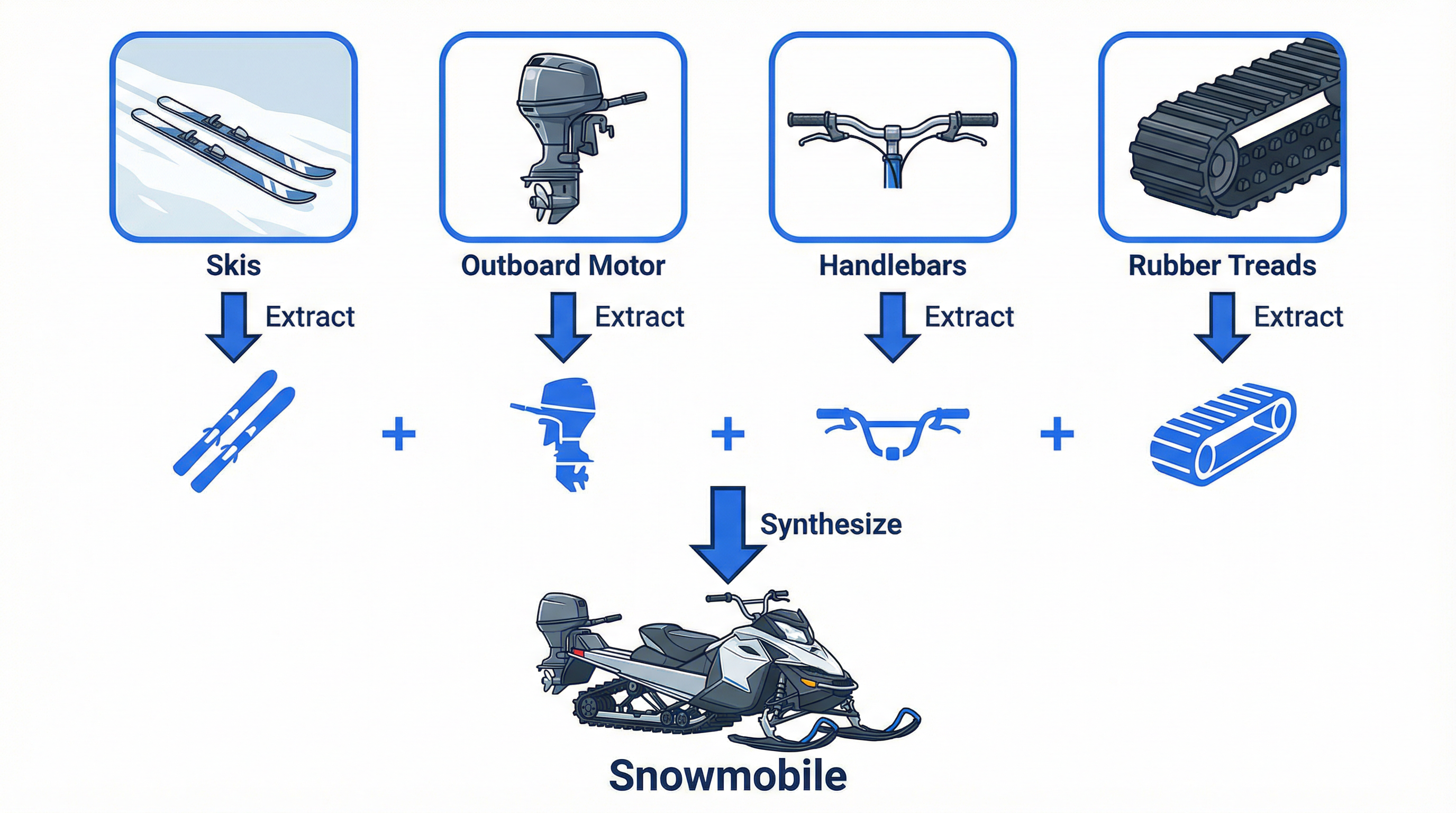
Imagine four scenes: Skiing on a slope. Motorboat in Florida. Bicycle on a spring day. Child fascinated by toy tractors with rubber treads.
Now pull apart (Destructive Deduction): Extract skis from ski slope. Extract outboard motor from motorboat. Extract handlebars from bicycle. Extract rubber treads from toy tractors. Discard the rest.
What do we have? Skis + Outboard Motor + Handlebars + Rubber Treads
Synthesize (Creative Induction): Pulling all this together = Snowmobile
"To discern what is going on we must interact in a variety of ways with our environment. We must examine the world from a number of perspectives so that we can generate mental images that correspond to that world. We use this scheme of pulling things apart (analysis) and putting them back together (synthesis) in new combinations to find how apparently unrelated ideas and actions can be related to one another." — John Boyd
Humans Make Sense
Humans excel at the 3Is: Intelligence (reflection, abstraction), Intentionality (purpose, choice), Identity (how we show up). We pull apart concepts from multiple domains and synthesize new solutions—we build the snowmobile.
Machines Compute
LLMs accelerate the 4-step cycle: faster survey of perspectives, rapid condensation, quicker pattern testing, accelerated iteration. They are the outboard motor—providing computational power to the human-driven synthesis.
The Division of Labor: I build snowmobiles by pulling apart concepts from Mission Command, TPS, Cynefin, Wardley Maps, and Orlikowski—then synthesizing them into new solutions for complex problems. LLMs are the computational engine that accelerates this process.Humans provide the sense-making and synthesis. Machines provide the computational power.
"Humans are not ants, or birds. We make things, play, and tell stories." — Dave Snowden
This is how I work: I build snowmobiles.
Learn Boyd's Methodology
Download the original Boyd documents to understand the foundations
These documents form the theoretical foundation of my approach. Study them to understand how cross-domain synthesis works.
Where the Experience Comes From
Diverse experience across military, manufacturing, and continuous learning creates unique problem-solving perspectives.
Military Service (23 Years)
Military Science / Systems Engineering, leadership foundation
5 years, multiple combat deployments including Operation Red Wings recovery
HUMINT analysis, targeting, counterintelligence, pattern recognition
Systematic analysis, decision-making under uncertainty, structured problem-solving
Business & Operations
Koch Industries: Analyst → Shift Coach → GenAI Champion
Oregon State Athletics, Soldiers to Sidelines: coaching, entrepreneurship, veteran transition
Lean principles, continuous improvement, cross-domain knowledge transfer
3,000+ pages capturing operational reality, pattern recognition at scale
Academic Background
The Strategic Game in Action: Monticello
A 2-year AI-enabled organizational transformation at Georgia-Pacific Monticello paper mill, demonstrating Boyd's 4-step methodology from initial survey to $546M enterprise-scale opportunity.
General Survey (Feb-Sep 2023)
Examined paper mill operations from multiple perspectives: manufacturing processes, training systems, leadership development, organizational culture, AI technology landscape, and operator knowledge capture.
Condense to Essential Elements (Oct 2023-Mar 2024)
Broke problem into core components: downtime patterns, operator knowledge gaps, documentation needs, adoption barriers, cultural resistance. Identified key question: "Can we use the Kata?" (Toyota improvement methodology). Condensed to mission-critical insight: Zero adoption in technology-first approach.
Place in Strategic Perspective (Apr-Nov 2024)
Synthesized patterns ACROSS domains to create new approach. Cross-domain synthesis: 2/75 Ranger after-action reviews → Shift knowledge capture system. Mission Command operator empowerment → Bottom-up AI adoption. TPS "respect for people" → Operator memory scaffolding (not replacement). Boyd's OODA loop → Real-time operational learning.
Implementation (Aug 2024-Apr 2025)
Embedded as Shift Leader to capture real data. Documented 1,408.7 hours of downtime across all shifts. Quantified $64M annual opportunity at Monticello. Scaled to enterprise level: $546M/year potential across 400 sites. Validated with live field data, not simulations. "No Capex. No Pilot. Just Recovered Execution."
Media & Recognition
Sharing insights on veteran entrepreneurship, coaching, and organizational transformation.
What If Entrepreneurship Is The Answer?
Exploring how entrepreneurship training and mindset can transform veteran transition and create pathways to meaningful post-service careers. Discussing the Hustlin4Results philosophy and veteran entrepreneurship ecosystem.
On Purpose: Veterans Find Meaning in Coaching
Featured profile on transitioning from 23 years of military service (2/75 Ranger Regiment, Intelligence) to coaching and organizational development. Discussing the Soldiers to Sidelines program and helping athletes and veterans find purpose through leadership development.
Let's Connect
Interested in discussing cross-domain problem-solving approaches? Want to learn more about the methodology? Let's talk.
Current Focus: Sharing practical approaches to multi-domain problem-solving, building teachable methodologies, and demonstrating how decades of systematic work create unique capabilities.